Anatomy of a Pokémon card
Pokémon cards are your attackers and your Prize cards rolled into one. Learn to read one and you can read all of them — the layout never changes.
Here's Miraidon. Every number below sits on the part it describes.
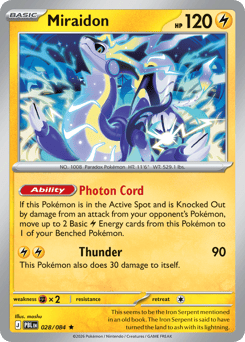
- 1Name and Stage — The Stage sits just above the name. "Basic" means you can play it straight from your hand onto your Bench. Stage 1 and Stage 2 have to be played on top of something already in play.
- 2HP — Hit Points — 120 here. When damage on this Pokémon reaches 120, it's Knocked Out. A typical Basic runs 60–130; the big attackers go past 200.
- 3Type — Lightning. Type decides what Energy powers its attacks and what it's Weak to. There are nine in Standard, plus Colorless.
- 4Ability — Photon Cord. Abilities work without attacking — some from the Bench, some from your hand. They cost nothing, and they're usually what makes a card worth playing.
- 5Attack — Thunder: two Lightning Energy for 90 damage, and it puts 30 on itself. The symbols on the left are the cost, the number on the right is the damage, and the small text is everything else.
- 6Weakness — Fighting ×2. If a Fighting Pokémon attacks this one, the damage doubles — 90 becomes 180. One symbol, and it decides whole games.
- 7Resistance — Empty here, and empty on every current Standard card. The slot still exists on the layout, and older cards use it to subtract damage, but nothing you'll face in Standard prints one.
- 8Retreat Cost — One Energy. To move this Pokémon out of the Active Spot you discard that many Energy from it — any type. High retreat costs strand a Pokémon out front.
Stages, and how a Pokémon enters play
- Basic — play it from your hand straight onto your Bench.
- Stage 1 — play it on top of the matching Basic already in play.
- Stage 2 — play it on top of the matching Stage 1.
You can't skip a step by playing a Stage 2 onto a Basic. (One Item card, Rare Candy, does let you — more on that in lesson 7.)
Rule boxes: ex and Mega
Some Pokémon carry an extra box of text at the bottom. That box is a warning label.
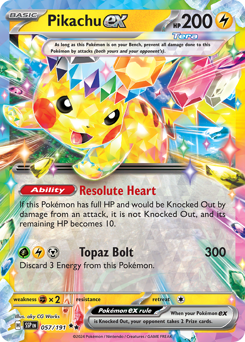
Pikachu ex hits for 300. The rule box is the price: when a Pokémon ex is Knocked Out, your opponent takes 2 Prize cards instead of 1. A Mega Pokémon — a Pokémon ex that has Mega Evolved — gives up 3.
So a deck full of ex Pokémon is a deck where your opponent only needs three good turns. That trade-off drives most deckbuilding decisions you'll ever make.
Quick check
Your opponent Knocks Out your Pikachu ex. How many Prize cards do they take?
Damage stays put
When a Pokémon takes damage, that damage stays on it between turns. It doesn't heal at end of turn. Players track it with damage counters — small markers worth 10 each — or with dice.
So a Pokémon with 120 HP that took 90 last turn is sitting one small attack away from a Knock Out. Reading the board means reading the damage already on it, not just the printed HP.
Next: the Trainer cards that make all of this actually work.