How a turn works
A turn has a strict beginning and end, and a lot of freedom in the middle. Once the shape is familiar, you'll start seeing a turn as a budget — and playing well is mostly about spending it well.
The fixed parts
- Draw a card. Always first. If your deck is empty when you have to draw, you lose on the spot.
- Do things. The flexible middle — everything below.
- Attack. Optional, and it ends your turn the moment you do it. You can also just pass.
The flexible middle
In any order, as often as the limits allow:
- Play Basic Pokémon onto your Bench — as many as you like, up to 5 on the Bench
- Evolve your Pokémon — each one once per turn
- Attach one Energy from your hand, to any Pokémon
- Play Item cards — unlimited
- Play one Supporter
- Play one Stadium
- Attach Tools — unlimited, but one per Pokémon
- Use Abilities — usually once per turn each
- Retreat your Active Pokémon — once per turn
The hard caps are worth memorising, because they're the whole shape of a turn:
Evolution timing
Evolving is the rule that trips up new players most, so here it is precisely:
- A Pokémon cannot evolve the turn you play it. It has to have been in play since the start of your turn.
- No Pokémon can evolve on your very first turn of the game — for the same reason: everything came down during setup. This applies to both players, on each of their own first turns.
- Each Pokémon can evolve once per turn. Basic → Stage 1 this turn, Stage 1 → Stage 2 next turn.
- Evolving removes all Special Conditions from that Pokémon. Damage stays; conditions don't.
A handful of cards are printed specifically to break the first two rules and say so in their own text. When a card's text and a general rule disagree, the card wins.
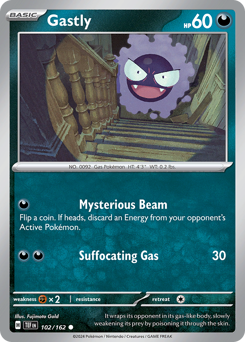
So Gastly comes down on turn one. On turn two it can become Haunter. On turn three, Gengar. Three turns to get a Stage 2 online — unless you shortcut it:
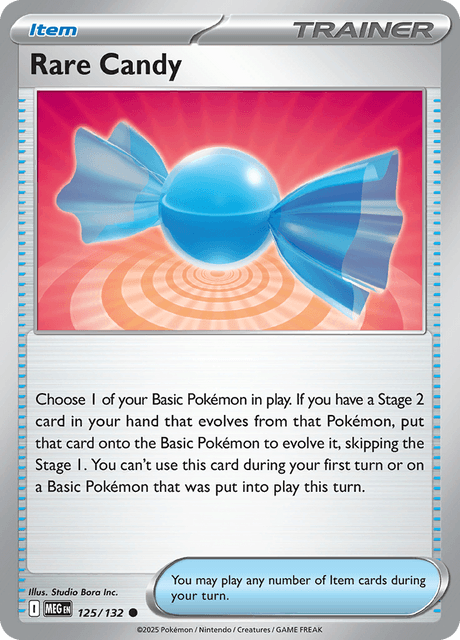
Rare Candy takes a Basic already in play and evolves it straight to Stage 2, skipping the middle. It's an Item, so it doesn't use your Supporter, and it's the reason Stage 2 decks are playable at all.
Quick check
You play Gastly onto your Bench, then want to evolve it into Haunter the same turn. Can you?
A worked turn
You have Gastly Active from last turn, one Bench slot filled, and a hand with options.
- Draw — you get Rare Candy.
- Play Ultra Ball, discarding 2 cards, to search out Gengar.
- Play Rare Candy on Gastly → it becomes Gengar immediately, skipping Haunter.
- Play Cheren to draw 3. That's your Supporter for the turn.
- Attach a Darkness Energy to Gengar. That's your attachment for the turn.
- Attack. Turn over.
Two Items, one Supporter, one attachment, one attack. Every cap respected, and everything uncapped stacked as high as the hand allowed.
Retreating
Once per turn you may retreat your Active Pokémon: discard Energy from it equal to its Retreat Cost, then swap it with a Benched Pokémon.
Two things fall out of that:
- The Energy is gone, not moved. Retreating a loaded attacker is expensive.
- Retreating clears all Special Conditions, because the Pokémon leaves the Active Spot. That's often the real reason to do it.
Next: what actually happens when you attack.